
These two buses are located at the Rockhampton Heritage Village

These two buses are located at the Rockhampton Heritage Village

Vauxhall Motors was founded in Vauxhall, London in 1857 under the name Alex Wilson and Company. They specialized in pumps and marine engines, and shortly after the company’s birth, changed their name to the less-ambiguous title of Alex Wilson Iron Works. In 1903, as an experimental trifle, the company constructed its first motor car–a 5-horsepower job with two forward gears and, unfortunately, no reverse gear. They began work to improve this design and soon emerged with a car suitable for public purchase. With the newfangled “horseless carriages” beginning to attract the attention and demand of buyers, Alex Wilson Iron Works picked up and moved to Luton where they were able to increase production, finally changing their name to Vauxhall Motors in 1907.
1925 brought about a bit of an upheaval for Vauxhall when, for $2.5 million, General Motors made Vauxhall an overseas subsidiary of their company. This event spurred a chain reaction that greatly affected Vauxhall’s design decisions. General Motors was being influenced by their competitor–the Ford Company–and that influence transferred across the pond to Vauxhall. What had until 1925 been a thoroughly British car was now distinctly American in flavour. When World War II began, Vauxhall put their car production on hold to build 5,600 Churchill Tanks.
The vehicle featured here is a Vauxhall Saloon (perhaps a Vauxhall 14/6 or a 25), most likely built right around the time World War II began–in 1937. The ads for Vauxhall vehicles from this era boasted the car’s ability to go from 0 to 80 in thirteen seconds and referred to the car as “an embarrassment of riches” and something “to meet world competition, ” which, given the company’s inadvertent imitation of the Ford design, was an accurate statement!
Owned by John Harrison

The Studebaker Gran Turismo Hawk (or GT Hawk),was a radical development in the form of a sporty coupe and was sold between 1962 and 1964. It was the final development of the Studebaker Hawk series that began with the Golden Hawk of 1956 .
The 1962 Studebaker was a unique design, as its styling was an assimilation of both European as well as American design marvels, and reflected a classic , smooth and aerodynamic styling.
The 1962 Studebaker boasted of several unique features including:
Engine: 2 or 4-barrel carbureted versions of Studebaker’s 289-cubic-inch (4.7-liter) V-8 engine (210 or 225 horsepower) teamed with standard three-speed manual, overdrive, four-speed or Flight-O-Matic automatic transmission.
Rectangular parking lights below the headlights
Woodgrain-effect dash and a tailored crash pad
Fine mesh covered front grille
Bucket seats and a console in the front, befitting a sporty-type car, and all seats were upholstered in either cloth and vinyl or all-pleated vinyl
Today, the 1962 Studebaker Gran Turismo Hawk is considered fairly collectable, although prices are affordable, reflecting the car’s specialist interests and the car enthusiast’s passion for milestone vehicles.

Owned by Greg and Kay Shuker.
In 1923, the Durant Motor Company, in its quest to export its Star motor cars outside America and Canada, found that the name Star had already been registered for commercialization in England. This prompted them to export cars under the trademark Rugby, which was incorporated with a few changes in some specifications relative to the Star production line.
The 1924 Rugby Tourer was a variant of the four cylinders Star Model F and had several unique features to attract the customer’s attention, such as:
Equipped with a nickel radiator and disc wheels. Furnished body panels in maroon or blue.
Engine: Continental W-4, four-cylinder, 3-1/8″ bore; 4-1/4″stroke; and 130.4 cubic inches displacement.
Piston: The piston and connecting rod assembly were detachable from the top or bottom of the case.
Tank: 10-gallon capacity fuel tank attached to the rear.
Transmission: Standard, selective sliding-gear type; three speeds forward and one reverse.
Brakes: External contracting; internal expanding; 10-inch brake drums
Carburetor: One-inch, single jet.
Cooling System: Honeycomb-type radiator, 16-inch fan, four blades, water pump, and 8-quart radiator capacity.
The Rugby car was produced at three Durant motor factories in the United States and Canada. However, the public identity of the 1924 Rugby was never stable due to the lack of consistently performing models coming out of the assembly lines.
If you have parts for sale or parts wanted, list them below in the LEAVE A REPLY section (bottom of page)

Owned by Bob and Marion Hudson
The Rolls-Royce Silver Ghost sedan produced during 1906-1925 is arguably the best car of its era. The name referred to the car’s GHOST- like quietness. Originally named the 40/50 h.p. the chassis was produced at the Manchester and Springfield factory
The aim of the Silver Ghost sedan was to raise public awareness of the company’s uniqueness and to show the reliability and quietness of their new car. This was a risky idea, as cars of this time were notoriously unreliable and roads of the day could be horrendous.
However the car was a huge success in the company’s history and the reputation of Rolls-Royce was set. The public image of the car was quite awesome as it provided the innovative features which were not experienced before-hand in the automobile history. Some of the car’s unique and attractive features include:
Engine: Six-cylinder cast in blocks of three each. L-head 4 ½ x 4 ¾ -inch bore and stroke
Suspension: Semi-elliptic leaf springs with Rolls-Royce friction shock absorbers
Suspension (rear): Cantilever type with Rolls-Royce friction shock absorbers
Brakes: Mechanical internal expanding on rear wheels
Frame: Ladder type with tubular cross members and front diagonal braces
Wheelbase: 143 ½ inches. Height: 143 ½ inches
Steering: Screw and nut
Transmission: Four-speed manual
Lavish luxury seating of the customer’s preference
The Rolls-Royce owes its longevity and stunning initial growth mostly based on the success of the Silver Ghost sedan which has fascinated car lovers all over the globe for so many decades.

Owned by Martin and Lynn Whitley.
The Pontiac cars were created by GM to fill a long-standing price gap between Chevrolet and Oldsmobile divisions in order to serve as a platform to share vehicle components in an effort to improve volume efficiency. But what it did create was a revolutionary transformation in the automobile industry.
The Pontiac took the market by storm and it was warmly welcomed by customers and car enthusiasts who were looking for something new. Soon the demand outpaced production and new production units were built only for the Pontiac series of cars!
In 1929 Pontiac introduced the Series 6-29 Big Six, which was originally a Vauxhall, the British subsidiary GM had acquired. The series features several auto-innovations worthy of its time , such as:
Pontiac’s first convertible (optional)
Engine displacement was 200.4 c.i., and hp increased significantly with respect to the previous version by 25 percent to 57 at 3000 rpm
Exterior color became popular, and Pontiac began offering an array of standard paint colors for every model
It is mention worthy that the Pontiac built its 500,000th car in 1929. However, in 1929 the stock market crashed, leading to the first decrease in demand for the 1929 Pontiac and its subsequent production losses due to the depression.
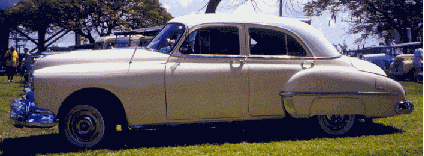
Owned by Cliff Crawford.
The 1950 Oldsmobile 88 was a full-size car sold by the Oldsmobile division of General Motors, which is heralded by car lovers as the precursor to the muscle car, due to its combination of a relatively small body and large, powerful engine.
The 1950 Oldsmobile saw the introduction of the revolutionary tail fin which was consequently adopted by several car makers of the time. While viewing the US air force’s F-58 “lightning” fighter planes in 1944, G.M’s legendary chief stylist, Harley Earl struck upon the idea of tail fins in automobiles .This set the GM artists to work designing the tail fins of all sorts to be adapted for use on automobiles.
Oldsmobile entered the 1950s following a divisional image campaign centered on its “Rocket” engines, and its cars’ appearances followed suit in their themes. The classic design was coupled with several innovative features such as:
A wide, “open maw” grille, suggestive of jet propulsion
Introduction of a ringed-globe emblem to attract universal appeal
A powerhouse V8 Engine , of 5 L capacity, and 303.7 CU IN displacement
The 4977 cc engine served up an astounding 135 Bhp of raw power – compliments of a two-barrel side-draft Rochester carburetor drawing air through a silencer and an oil bath deluxe air cleaner.
The Whirl away hydraulic transmission providing excellent power transfer.
Coil springs at each corner of the car cushion the ride, as the 7.60×15-inch tires support the 119.5-inch wheelbase.
The 1950 Oldsmobile 88 enjoyed a great success, inspiring a popular 1950s slogan, “Make a Date with a Rocket 88”, and also a song, “Rocket 88”, often considered the first rock and roll record.
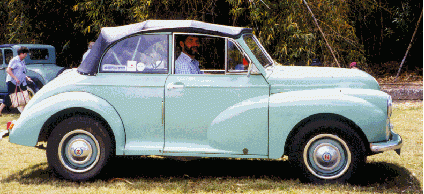
Owner Alan Dawes
The Morris Minor was a well established and respected small, family sized car, which contested for the title of “the world’s supreme small car” for over 3 decades of production history in the form of several renowned variants.
The Minor offered several technical innovations at a budget price which characterized its public appeal. The Minor, which was known as the Mosquito during development was originally planned to be powered by an air-cooled, horizontally-opposed 800cc four-cylinder engine. For a number of reasons, including the relaxation of Government legislation which had taxed larger-capacity engines, production models were actually fitted with the reliable old 918cc side valve unit.
The Minor’s several variants boasted of numerous innovative features such as:
The mono-construction body.
Independent front suspension.
Seating arrangements, with all passengers seated within the wheelbase.
Superb, pin-sharp rack-and-pinion steering.
In 1956 Morris Minor fans were thrilled by the introduction of the Morris Minor 1000, powered by an improved A-series engine of 948cc S4 OHV. The new engine gave the 1000 the capability of higher cruising speeds and generally more flexible drivability.
In 1962 what would be the last of the Morris Minor / 1000 series derivatives arrived on the scene, the (1098cc) Morris 1000. The new 1000 introduced some worthwhile improvements, the biggest change of coarse being the new, larger capacity engine and the new dashboard layout.

Owned by Brian Holmes.
The Jowett Jupiter sports cars, powered by a 1486cc flat four pushrod engine of 60-62 BHP, were designed by Jowett and Gerry Palmer and are a good example of British engineering eccentricity.
The engine’s clutch housing is detachable; the gearbox and starter motor attach to it. The pushrods can be accessed beneath the black cover plates on the top of the engine. The horizontally opposed four-cylinder unit of bore 72.5mm x stroke 90 mm engines had a compression ratio of 7.6:1 or 8:1.
Other innovative and admirable features include:
Transmission: This compact transmission offers 4 forward ratios (synchromesh on 2nd, 3rd, and top) plus reverse. The gear lever is steering-column-mounted.
Steering: The steering is done by a solidly mounted rack-and-pinion unit, which is rare for its time. As a result, the steering is light and positive.
Brakes: The brakes are all-around hydraulic, with twin leading shoes at the front. The brake shoe area is very adequate except for fast mountain descents, when fade will be experienced.
Suspension: Front suspension is independent, unequal-length wishbones with torsion rod springs and telescopic shock absorbers.
Rear suspension (Mk1, Mk1a) is live axle, well-located by Panhard rod (no axle tramp), with transverse torsion rod springs and telescopic shock absorbers.
Miscellaneous:
Length : 168in / 427cm
Height : 56in / 142cm
Width : 62in / 157cm
Wheelbase: 93in / 236cm
During its production life and beyond, Jupiter Sports did not disgrace itself in national and international competition rallies and races. Historic races and rallies provide happy hunting grounds for the Jowett Jupiter sports cars.
Exploring the Jowett Jupiter: A Jewel of British Engineering – The world of classic cars is filled with unique stories and standout models, but few have the charm and character of the Jowett Jupiter. Designed by Jowett and Gerry Palmer in the 1950s, this sports car embodies a spirit of British engineering eccentricity that continues to capture the hearts of enthusiasts today.
The Specs Behind the Style – At the heart of the Jowett Jupiter is its impressive 1486cc flat-four pushrod engine, which produces a modest yet spirited 60-62 BHP. While these figures may not seem groundbreaking by today’s standards, they offer a peek into the era’s engineering philosophy—where performance was often about balance and efficiency rather than sheer power. The carefully crafted engine ensures a fun driving experience and showcases a unique approach to automotive design that sets it apart from its contemporaries.
Design and Aesthetic—The Jowett Jupiter’s design is both classic and distinctive. With its sweeping lines and sporty curves, the car exudes elegance and retro charm. It’s a beautiful example of how aesthetics can blend seamlessly with functionality. The vehicle’s lightweight construction allows for nimble handling and responsiveness, making it popular among driving purists.
A Slice of History –The Jowett Jupiter was introduced in a post-war era when many manufacturers experimented with new concepts and ideas. The car is a testament to British resilience and creativity during renewal and innovation. With its small production numbers, the Jupiter has become a rare gem in the classic car market, representing a unique chapter in British automotive history.
Driving the Jupiter – The driving sensation is captivating for those lucky enough to experience the Jowett Jupiter firsthand. The car’s blend of power and lightness provides an engaging connection to the road. Whether navigating winding country lanes or cruising down the boulevard, Jupiter’s performance remains a delightful reminder of what driving is all about—fun and freedom.
Why the Jowett Jupiter Matters Today – The Jowett Jupiter is more than just a classic sports car; it symbolizes a unique perspective on engineering and design. Jupiter encourages enthusiasts to appreciate automotive history’s quirks and eccentricities in a world increasingly dominated by standardization. Owning or even just witnessing a Jowett Jupiter is an opportunity to engage with a piece of history that reflects the culture and creativity of its time.

Owned by Greg and Helen.
Humber was a British automobile marque which was started by Thomas Humber in 1868 and grew into one the largest and most well renowned British automobile manufacturer of all time.
One of the most famous cars coming out of its production lines was the 1933 Humber Snipe and Pullman sedan . The four door sedan’s the power unit was a straight six of 3,948.5 c.c. with a bore and stroke 80×116 mm and over-head inlet and side exhaust valves.
Other mechanical innovations utilized in this car included:
A mechanical fuel pump
Radiator shutters operated by thermostat in the header tank
Engine and gearbox in one unit with Silent-bloc trunnion mountings
A starter motor with 2 to 1 drive to ensure that the engine
was spun rapidly when old
A new frame with deep-section sides had an extra stiff and deep triangulated cross member in the middle
Suspension was, of course, non-independent with beam axles and half-elliptic springs
A new downdraught carburetor.
In 1931 when the Rootes Brothers bought a majority shareholding, the Humber lost its independent innovations , as numerous designers left Humber, lacking the freedom of work space.. But eventually the Humber model regained its market share lost during the depression period and brought “the eccentricity” back into the British Automobile market.